The rise of AI is flooding the internet with generic content. This makes human trust and personal brand more crucial than ever. Top entrepreneurs and creators from Gary Vaynerchuk to MrBeast all echo this: your personal creator brand is becoming more valuable than any corporate logo in this new era. Your reputation, face, and unique perspective are your greatest assets.
Below, we break down the common insights these 14 experts agree on, their contrarian strategies, and what it all means for you.
Common Ground: The New Rules Everyone Agrees On
All these creators share a surprisingly consistent worldview about branding in the AI age. From tech CEOs like Sam Altman to content moguls like Alex Hormozi, the focus has shifted toward human-centric principles.
Personal Brand Is Priceless in an AI Driven Content Flood
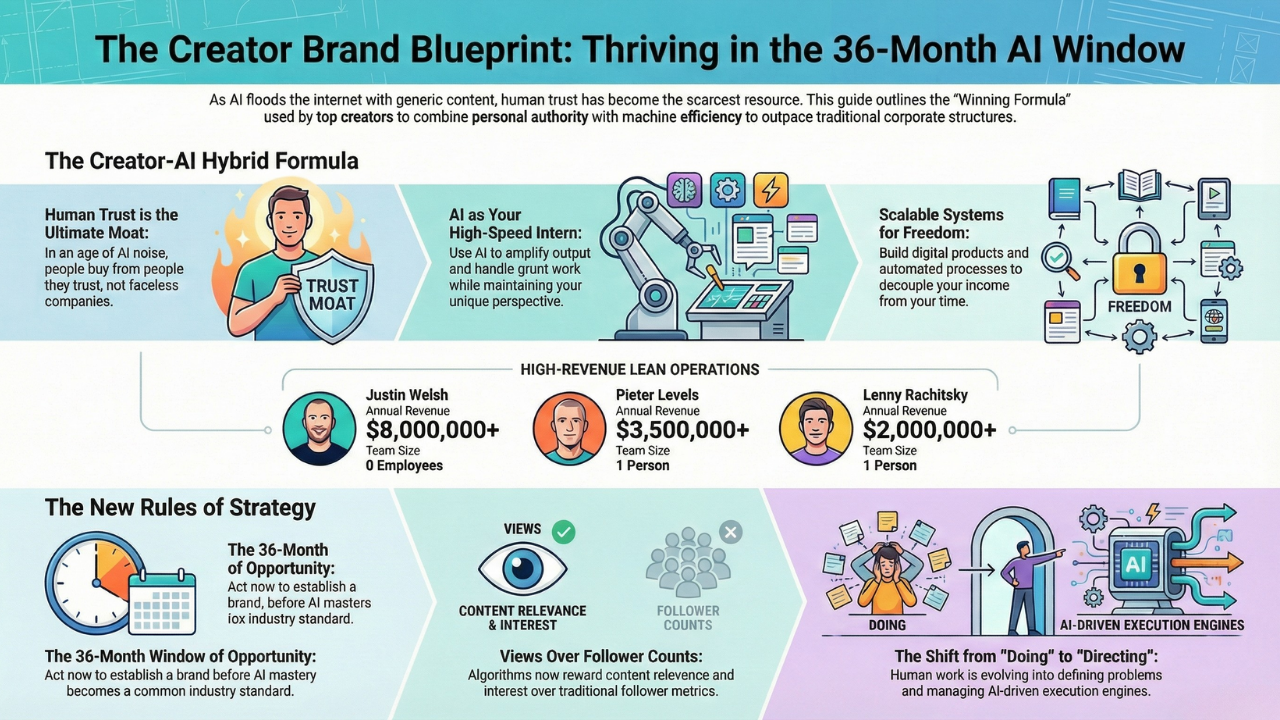
When AI can pump out endless blog posts, videos, and images, authenticity becomes gold. Generic corporate content is everywhere. What cuts through the noise is trust in a human face. People trust people, not faceless companies. Your name and credibility represent a moat that AI cannot clone overnight.
In a world of AI generated noise, the scarce resource is human trust. Your personal brand is how you earn it. Statistics show that people are significantly more likely to trust and buy from individuals with a strong personal brand. The takeaway is simple: people buy from people they trust.
Distribution and Attention over Production
Content creation is no longer the hard part. AI has made generating posts, images, and even code fast and cheap. The bottleneck now is getting anyone to see your content. In 2026, content is no longer the scarce resource. Credibility is the real prize.
With infinite content around, capturing attention and trust is the real game. You should not worry about your ability to churn out enough posts because AI can help with that. Instead, you should worry about distribution and differentiation. This means getting content in front of the right people and making it authentic enough to hold their attention. We are in the era of interest media where algorithms reward content that people find relevant, regardless of follower counts.
AI is Your Assistant Not Your Replacement
Every creator here sees AI as a tool to amplify your capabilities rather than a threat to your existence. The most interesting skills cannot be taught or automated. They are the product of your unique life and curiosity. AI can handle routine tasks or generate drafts, but it lacks human judgment, taste, and the deeper purpose behind content.
The consensus is that you should absolutely leverage AI. Use it to brainstorm or save time on editing, but always inject your own context and point of view. Think of AI as an intern that works at super speed. The winners will be those who embrace AI as a collaborator to increase their output while still providing the human creativity and authenticity that AI cannot replicate.
One Lean Creator Can Rival a Big Company Thanks to Tech
It sounds crazy, but it is already happening. One person businesses are hitting seven and even eight figures in revenue, something traditionally only large companies could do. Creator Justin Welsh, for example, built a solo business to over 8 million dollars in revenue with zero employees. Pieter Levels operates a suite of apps pulling in over 3.5 million dollars a year as a solo founder. Lenny Rachitsky’s one man newsletter reportedly makes over 2 million dollars per year.
These lean operations use software, automation, and community goodwill to scale without headcount. Technology and AI provide so much leverage that experts forecast we will soon see 10 person billion dollar companies. There is even a betting pool for the first year there will be a one person billion dollar company. Solopreneurs and tiny teams can compete with the giants by using code and media as leverage. A savvy creator with AI and software leverage is effectively a 100 person staff.
Consistency and Long Term Thinking Beat Growth Hacks
Almost all these creators preach the power of patience and consistency over any one trendy tactic. Alex Hormozi often shares that his massive book launch only happened after four years of grinding out content and ads every day. It looked like an overnight success, but it was really the product of daily videos and refining his message over years. Similarly, MrBeast spent over five years making YouTube videos before one went viral. He had under 1,000 views on most early videos and just kept improving bit by bit.
This approach of giving value first and harvesting later contradicts the idea of quick wins. The universal rules here are to show up reliably, put in the reps, and let compounding work its magic. Audiences grow exponentially if you stick with it. The game is won by the person who outlasts the competition, not the one who finds the best hack.
Hybrid Model Wins: Personal Brand and Scalable Systems
Being just a creator or just a company is not enough. The future belongs to hybrids. This means you cultivate a strong creator brand consisting of your personal reputation and audience while building systems that can execute and monetize beyond just you. Relying purely on being a creator is risky because platforms can change. Relying purely on a faceless company is also tough because you will lack differentiation and organic trust.
The solution is to be the face and the brains while having an engine behind you. You serve as the relatable expert that people connect with, while your systems and processes handle transactions and scale. For example, Sahil Bloom leverages his audience to launch companies, and Justin Welsh sells courses while rarely doing one on one client work. You are the intellectual property. Build an infrastructure around yourself so you are never fully dependent on algorithms or stuck as an impersonal entity.
Unique POV and Real Experience are the Lasting Moats
Several creators warn that flashy production or looking corporate is not a durable advantage. This is especially true since AI can now crank out slick graphics and mimic authentic styles. What actually lasts is having specific knowledge, sharp taste, and real experiences that inform your content. The most interesting things cannot be taught, meaning the unique insights you earn from your own journey or obsessions are your edge.
Taste is becoming the new intelligence in an age of AI ubiquity. When content and answers are abundant, the value comes in knowing which problems to solve and having a perspective that is not copy and pasted. Authenticity used to mean a casual aesthetic, but now that AI can fake a low fidelity look, authenticity must run deeper. It is about specific context, stories, and evidence of your real expertise. Do not worry if you lack Hollywood production quality. Instead, worry about sharing insights that only you can share. Your personal point of view and your earned secrets are the most.
Speed to Market is Accelerating
The creators agree that speed is a massive competitive advantage. Opportunities will not stay unique for long because AI and no-code tools allow everyone to spin up products and content quickly. We have already seen glimpses of this with solo founders hitting major revenue milestones in just a matter of days. AI enables coding and insight discovery at speeds that compress projects from months into days.
If you have a great idea, assume someone else will execute it fast. You need to move with urgency. The good news is that you can leverage these same tools to outrun bigger but slower competitors. Many experts predict a specific window where early movers can establish strong positions before the playing field evens out. Whether it is starting a newsletter or launching a small software project, start sooner rather than later. Speed does not mean being sloppy; it means not overthinking and actually shipping. Launch a bare bones version to test an idea rather than spending months in stealth mode. In the AI age, being done first might be better than anything else.
Work is Changing: Less Doing and More Directing
AI is automating a significant chunk of knowledge work, but that does not mean humans have nothing to do. Instead, our jobs are shifting to what only humans can do: define problems, guide AI, and judge outputs. Experts suggest that in the near future, one person will be able to achieve far more than ever before due to AI helpers boosting their productivity.
Think of AI agents as team members. We are moving toward a reality where you might have a handful of AI agents in your organization handling customer support, research, and drafting. The skill to cultivate now is the management of AI and high level creativity rather than grinding out drudge work. Creators who learn to effectively brief AI by feeding it personal context and quality data will outperform everyone else. You will be like an orchestra conductor with many AI instruments at your disposal, but you decide the composition. Soft skills like community building, storytelling, and empathy become even more valuable when bots handle the tedious stuff.
Real Experience First and AI Amplification Second
You cannot skip the actual learning and doing part of your career and expect AI to fill the gaps. You cannot prompt engineers on their way to becoming a world class expert. Specific knowledge is the wisdom gained from your personal pursuits and passions, and it remains the key to impact. That kind of insight is what makes a creator brand powerful, and it only comes from engaging deeply in the real world.
AI can take your hard won knowledge and help you scale it. It can summarize years of experience into a book or turn your ideas into social media threads. However, trying to use AI to fake expertise you do not have will result in shallow content. The baseline for what gets results has been raised. Anyone can have AI churn out a generic article, so the people who stand out are those with genuine substance behind the polish. Live the experience first, then leverage it.
Use AI to amplify your real work rather than becoming an AI content puppet. Feed the tools your unique stories and data so you do not simply recycle the average of the internet.
Those are the common pillars that all 14 creators more or less agree on. In summary: build a personal brand founded on trust and unique insight, use AI and automation to scale yourself, stay lean and fast, be consistent, and focus on human connection. Now let us look at some specific, contrarian tips each of these thought leaders suggests. These are the nuances where their individual playbooks diverge.
Uncommon Takes: 14 Contrarian Strategies from Top Creators
Even though they share a lot of beliefs, each creator also has at least one unique strategy or contrarian belief worth noting. These are the ideas that not everyone agrees on, but they might contain gems for you to consider.
Alex Hormozi: Scale What Works and Delay Diversification
Alex argues against the typical advice of spreading your bets early. His approach is to find your one winning channel or offer and pour gasoline on it before doing anything else. For example, if a specific ad channel is profitably acquiring customers, do not pause to launch a podcast or expand into a new market. Instead, push that channel to its limit and squeeze every drop of growth from it.
Only once you truly saturate a tactic should you branch out. This stance flies in the face of the mantra to try every platform. Hormozi believes most businesses never fully capitalize on one source of traction because they get distracted by the next thing too soon. Focus on becoming the best at one distribution method or one product and exhaust its potential before adding new ones. This ensures you build a strong core engine and learn what really drives your business.
Justin Welsh: Solopreneurship as the Endgame
Justin champions the idea that bigger is not always better in business. His contrarian take is that staying a one person business can be the ultimate goal rather than just a stepping stone. He openly optimizes for freedom, simplicity, and ultra high profit margins over aggressive expansion. His business makes millions with nearly 90% profit margins and no employees, which is almost impossible in traditional companies.
While most people suggest that success eventually requires hiring a team or raising capital, Justin disagrees. He prefers to have total control of his time and craft rather than managing people or chasing exponential growth. This is contrary to the Silicon Valley mindset of scaling at all costs. It proves that a lean personal brand business can be extremely lucrative and personally fulfilling. You do not have to turn into a large agency or a venture backed startup. You can deliberately choose to stay small and measure success in lifestyle and profit rather than headcount.
Sahil Bloom: Creator Led Holding Companies
Sahil has taken an unusual path. Instead of just building one audience-based business, he uses his audience to spin up many businesses around other experts. He is essentially building a holding company that partners with creators who act as the front faces, while he provides the back-end team to execute the services or products.
For example, Sahil might team up with a well-known YouTuber to launch an agency that offers services to that YouTuber’s fans. The creator lends their brand and audience, while Sahil’s side builds and operates the business. Both then share the profits. This is a contrarian hybrid of influencer marketing and traditional company building. Rather than hiring a bunch of employees under one brand, he franchises the model to other personal brands. This way, he is not limited by his own audience size alone. He treats distribution as the key asset and plugs in whatever business meets that audience’s needs.
Pieter Levels: Launch Ugly and Early
Pieter’s mantra is to ship it now and polish it later. He is notorious for launching minimal versions of products just to test if people want them. He even uses fake payment gates, putting a checkout button on a new feature before it actually exists. If nobody clicks buy, he does not build the feature. If they do, he refunds them and begins development.
This approach contradicts the classic wisdom of making a great first impression. Pieter believes the market reaction determines if a product is worth making pretty. This philosophy allowed him to try dozens of ideas quickly and find the few hits among them. He famously launched over 70 projects, most of which failed fast, while a handful became massive successes. The lesson is to avoid over-engineering your work. Use real world usage as your guide for where to invest effort. This scrappy ethos is a superpower for creators who want to move fast.
Lenny Rachitsky: Give Value for Free for 9 Months
Lenny’s take on monetization timing is simple: wait longer than you think you should. He wrote his newsletter as a free weekly email for nine months straight, building up over 25,000 subscribers before adding a paid tier. While many creators try to charge immediately, Lenny focused on trust and audience goodwill first.
By the time he launched a paid subscription, people were practically asking to pay him. His newsletter then skyrocketed to become a top performer in its category. He proved that patience in monetization can lead to greater long term revenue because you have created so much upfront value. This runs contrary to the monetize early and often mindset. It is about strategic sequencing: earn trust and build a habit with your audience, then capitalize on that equity. If you can afford to, do not rush to sell. Give until the audience is primed and asking for more.
Dharmesh Shah: Treat AI Agents as Teammates
As the co-founder of HubSpot, Dharmesh has a front-row seat to the AI revolution. His contrarian idea is to stop thinking of AI tools as just software and start thinking of them as semi-autonomous employees. He believes AI agents are not meant to replace your team, but rather to join it.
This mindset is a major leap for managers who see AI only as a threat or a simple tool. Dharmesh suggests incorporating AI into organizational charts and workflows with defined roles, just as you would for a human. Having several AI agents working around the clock on lead generation, coding, or customer support allows your human team to focus on higher-order work. The competitive advantage goes to those who build human-AI hybrid teams. Treat AI with the same clarity as a new hire: train it, give it goals, and measure its output.
Sahil Gandhi: Be the Brand, Build the Machine
Most treat a personal brand as a marketing layer; Sahil Gandhi treats it as the engine. As the creator of Brand Professor, he argues that the AI era has rendered massive teams and paid ads secondary to sharp positioning and daily relevance. His philosophy centers on building a brand people talk about when you’re not in the room, shifting the focus from mere visibility to lasting authority.
His contrarian take is to stop building a business with content and start building a business model out of your content. This means showing up with high-signal insight every day and designing offers around your unique lens. Rather than using content to entertain, Sahil uses it to teach the market how to buy from you, prioritizing clarity and conviction over vanity metrics.
To achieve true scale, Sahil emphasizes "Infinite Leverage Assets", signature frameworks, brand IP, and workflows where AI scales your brain rather than just your output. This creates a hybrid identity where you remain the face of the brand without becoming its bottleneck. The result is a system that continues to work, convert, and compound long after you log off.
Dan Koe: You Have 36 Months to Make It
Dan has been sounding an optimistic alarm that we are in a unique window of massive change. His contrarian angle is a heavy sense of urgency. While many preach patience, he argues that the playing field will dramatically shift by 2026. This period is the last time when the combination of human creativity and AI mastery will be an uncommon advantage.
By 2028, AI will be in every workflow and personal branding will be the norm. His advice is to act now to build your brand and launch your business before the curve gets too steep. He frames this period as a land grab. Do not wait to see how AI pans out; building your presence immediately is the only way to avoid competing with much more entrenched players later. In his view, you must build your ark before the flood hits.
Naval Ravikant: Specific Knowledge Cannot Be Taught
Naval’s core teaching is contrary to how society raises us. He insists that the most valuable knowledge is specific to you and cannot be learned from a standard class or book. If a skill can be easily taught to 1,000 other people, it is not your differentiator. This flies in the face of hustle culture, which often encourages people to copy what is already working.
Naval argues that your true edge comes from pursuing your genuine obsessions and combining skills in a unique way. If you combine separate interests like coding and psychology, you create a niche that only you can fill. AI and globalization will commoditize general skills, so you must become a specialist based on your own curiosity. If you can be trained for it, a computer can eventually do it too. Embrace the unique mix that makes you hard to label; that is how you build a brand that cannot be copied.
MrBeast: Make Philanthropy Your Content
MrBeast took a path that traditional corporations rarely do: he made giving away money and doing good deeds a core part of his brand of entertainment. This is a contrarian move because most companies separate their serious business content from their charity work. Jimmy merged them into one.
Videos featuring outrageous generosity are his primary content. The genius of this model is that it creates a virtuous cycle. Viewers love the feel-good nature of the stunts, which drives more views, providing him with more resources to continue his philanthropic projects. The takeaway is to not be afraid to wear your cause on your sleeve. If you care about a mission, let it shine in your main brand narrative. This builds goodwill and loyalty in a way that aligns with your identity. Just ensure it is authentic, as audiences can easily detect when someone is being generous just for the sake of public relations.
Gary Vaynerchuk: Measure Views Over Followers
Gary Vee argues that the old model of social media, where you post and only your followers see it, is dead. We have entered the age of interest media, where algorithmic feeds are dominated by what people find valuable, not who they are friends with. His contrarian twist is that followers matter less than ever before.
A person with zero followers can get more views than a celebrity if they post something the audience actually wants. Conversely, someone with a million followers can post something weak and reach almost no one. Gary suggests you should act as if you have no followers and every piece of content must earn attention from scratch. This means optimizing for shareability and relevance is more important than vanity metrics. Every post now competes on its own merit. Measure your success in watch time and engagement rather than how many people clicked follow on your profile.
Varun Mayya: Mobile for Consuming and Desktop for Creating
Varun has a nuanced take on productivity: your device often dictates your mindset. When we are on our phones, we are usually in consumer mode, scrolling and snacking on content. When we are at a desk, we switch to creator mode, using a larger screen and multiple tools to build and write.
While many hustle gurus claim you can run a business entirely from your phone, Varun suggests this is a mistake. Groundbreaking work rarely happens on a small screen where notifications compete for your dopamine. Be intentional about your environment. Use your phone for quick research or light engagement, but sit down at a computer for heavy lifting. Respecting the context of your tools allows you to enter a focused maker mindset and produce higher quality output.
Tim Ferriss: Find Niches Big AI Will Not Penetrate
Tim Ferriss and venture capital legend Bill Gurley suggest that while broad AI like ChatGPT will handle general knowledge, deep niche verticals remain open for individual creators. Specialized areas that require proprietary data, local expertise, or domain specific trust are often too small for tech giants to prioritize.
This is a reassuring angle: AI is coming for a lot, but it is not coming for everything. An AI model fine tuned on local agricultural data or a community built around a hyper specific hobby is unlikely to be a target for Google or OpenAI. Look for the gaps where you can combine specific know-how with personal brand trust to solve a problem better than a generic tool. Focusing on a long tail niche can be more defensible than trying to compete in a general arena. Build the best solution for a specific need that the big players are too broad to cater to.
Lenny Rachitsky: Give Value for Free Before Monetizing
In a hustle culture that screams "monetize fast," Lenny’s path stands out. When he started his newsletter, he deliberately kept it 100% free for nine months, even as his subscriber base grew into the tens of thousands. Only after establishing a deep reputation and a hungry audience did he introduce a paid tier.
This is contrarian because typical advice suggests monetizing early to prove your business model. Lenny did the opposite: he proved the value and trust first, then charged. The result was an almost instant wave of paid conversions because readers had built up so much goodwill.
He recommends that new creators focus on building an audience and trust for as long as they can financially afford to before asking for money. This long-game approach builds a far stronger foundation with extremely low churn. While others try to sell products the moment they hit 1,000 followers, Lenny shows that patience and generosity create a level of reciprocity where your audience genuinely wants to support you when you finally offer something for sale.
What This Means for You: 2026–2029 Game Plan
To win in the next few years, founders and creators must combine human trust with machine efficiency. Here is the distilled game plan for the coming era.
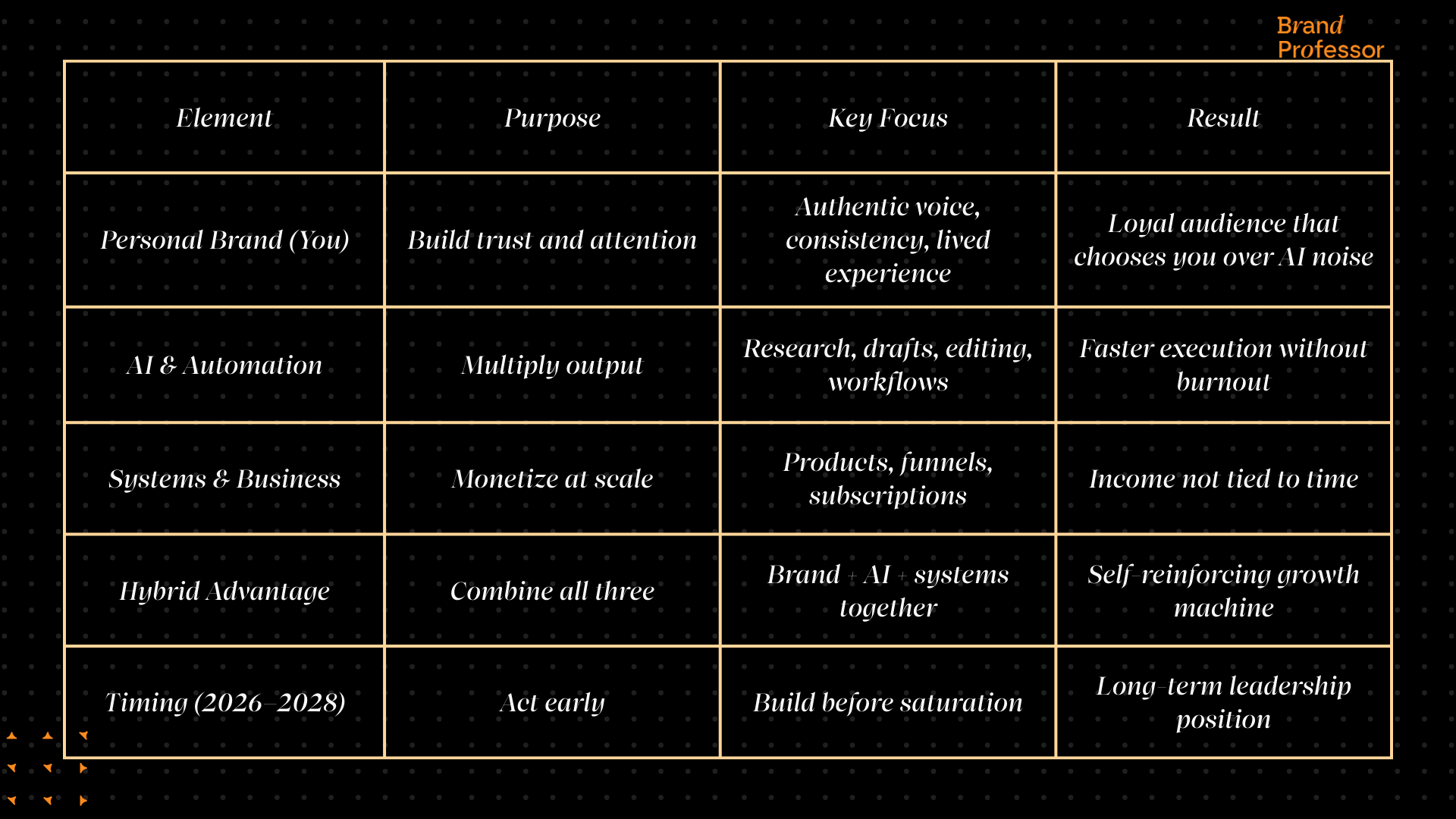
The Winning Formula: You + AI + Systems
Think of your success as a simple equation involving three core components.
1. You: The Creator Brand
This is your voice, your unique experience, and your character. In an internet filled with AI content, you are the reason people will listen. Your personal brand is an attention magnet that faceless competitors cannot replicate.
Invest in this by sharing your journey and showing up consistently. Post value-driven content daily if possible to build the "know, like, and trust" factor. Most importantly, feed the AI your context rather than letting it dictate yours. Use your real-world knowledge to create original takes that an AI could never generate on its own.
2. AI and Automation: The Invisible Infrastructure
This is your execution engine. Integrate AI to handle as much grunt work as possible, including research, first drafts, video editing, and customer service. The goal is to multiply your output without increasing your effort.
If you currently write one article a week, AI should help you produce three by handling outlines and initial edits. Use automation tools to run processes in the background so you can effectively clone yourself. By 2030, a single person’s productivity will be significantly higher thanks to these assistants. Just remember to always provide human oversight to ensure the quality remains high and the results do not feel robotic.
3. Systems and Business: Monetization Without You
This piece is about making money sustainably without trading your time for every dollar. It involves building products or services that can be sold at scale, such as online courses, software, or community subscriptions.
Your personal brand brings people in the door, but your systems convert that attention into revenue. Design an ecosystem where customers can buy from you without requiring you to be on a call for every transaction. This is how you achieve true freedom of time. Whether it is a paid newsletter or a physical product, build something that earns money while you sleep.
When you combine all three elements, Personal Brand, AI Leverage, and Scalable Systems, you get a self-reinforcing machine. You attract and build trust; AI helps you deliver value faster and more frequently; Systems monetize that value and fund further growth. Many people have one or two of these, but the real magic is the hybrid. It is about combining different types of leverage, labor, code, and media, for maximum effect.
Timeline and Urgency: The Clock is Ticking
Let's talk about timing. We are currently in a unique window of opportunity. By 2028, AI and personal branding will still be massive, but the "early adopter" advantage will have mostly vanished. The game is shifting from the "Wild West" to a set of established rules. Treat the next two years as critical for laying your foundation.
Consider the speed of current shifts:
- Sam Altman’s Forecast: By 2026, AI is expected to move past simple pattern matching to discovering novel insights in science and engineering. By 2027, we expect the arrival of autonomous robots capable of performing complex tasks in the physical world.
- Rapid Scaling: We are already seeing solo founders reach incredible milestones at record speeds. For example, Pieter Levels recently launched an AI-powered project that hit $67,000 in monthly revenue in just three weeks.
- The Adoption Curve: Tech adoption is steeper than ever. The mainstreaming of these tools is now measured in months.
If you start building your personal brand and AI-powered operation now, you can still be ahead of the pack. If you wait until 2030, you will be playing catch-up in a crowded field. The "land" in this new economy is cheap right now, but soon, the best plots will be owned. There is still room to be the leader in your industry who fully embraces these principles.
Your Next Moves: Practical Steps to Bet On
Considering everything, here are the concrete moves you should make as we head into 2026 and beyond:
1. Emphasize Thinking Over Production
Do not try to win by having the glossiest AI-edited videos or the most perfect graphics. In an era where AI can generate professional-looking "slop" in seconds, the competitive advantage shifts to insight and authenticity.
- The Strategy: Instead of focusing on high-end production, focus on sharing a uniquely insightful take. Position yourself as the "experienced practitioner" in your niche.
- The Reality Check: It is perfectly fine if your video is just you talking to a webcam, provided that what you are saying is valuable. Quality of ideas will always beat flashy production in a world saturated with generic AI content.
2. Distribute Relentlessly
Become a distribution machine, or partner with one. In 2026, we have firmly moved from the "Social Media" era into the "Interest Media" era. Algorithms, not follower counts, now determine who sees your work.
- The Hustle: Post daily if possible and repurpose your core ideas across every platform. If AI makes production easier, you should redirect that saved energy into your distribution strategy.
- The Algorithmic Play: Since platforms now prioritize relevance over pre-existing relationships, every piece of content must earn attention from scratch. Ensure your message maps directly to what your audience cares about, and the "algorithm gods" will reward you with reach far beyond your current followers.
- The Ownership Shift: While you distribute on social platforms, aim to move your most loyal fans into spaces you own, such as email lists or private communities. This protects you from the instability of changing algorithms.
3. Tighten Your Offers: Productize Your Value
If you have grown an audience but are still relying on one-off sponsorships or hourly consulting, make this the year you productize. The goal is to package your expertise into assets that do not require your 1:1 time for every sale.
Consider what top creators are successfully selling:
- Digital Assets: Templates, checklists, or e-books that solve a specific problem.
- Scalable Learning: Cohort-based courses or membership portals.
- Serviceized Software: Micro-SaaS tools or specialized AI prompts.
Use AI to help build a "beta" version of your product quickly, whether that is drafting a course curriculum or generating code for a simple tool. Don't let your brand sit idle; build an engine that delivers value even when you aren't on a Zoom call.
4. Invest in Your "Trust Bank"
In the "Credibility Economy," being believable matters more than being loud. Humans prefer to buy from those they feel a genuine connection with, and trust is the only currency that AI cannot devalue.
- Be the Proof: If you advocate for a strategy, show your own results. Share your numbers, your case studies, and even your failures.
- Transparency at Scale: Use your content to "show your work." This creates a reserve of trust that protects you from algorithm shifts or generic competitors.
- Authentic Authority: While AI can mimic knowledge, it cannot mimic lived experience. Lean into your personal stories to prove your expertise is real.
5. Adapt Your Skillset Continuously
The most successful creators share a common trait: a growth mindset. In the AI age, your most valuable meta-skill is the ability to learn new tools rapidly while holding tight to timeless fundamentals like empathy and strategy.
- Weekly R&D: Set aside an hour each week to experiment with a new tool or content style.
- Stay Curious: Don't be the person who says "I don't get it" or "it scares me." The people who dismissed the internet in the late 90s were the ones left behind a decade later.
- The Hybrid Advantage: Don't aim to be the "best AI-anything." Instead, be the person with the sharpest thinking and the best human voice, who happens to execute 10x faster because you’ve mastered the tools.
Conclusion: The Rise of the "Director" Class
We are living through a fundamental redefinition of what it means to work. The "grind" is being automated, leaving behind a massive vacuum that only human creativity, judgment, and connection can fill. As we’ve seen from these 14 world-class creators, the goal isn't to beat the bots, it’s to lead them. Today’s trend is - Entrepreneurs maintain a cohesive brand.
By 2030, the most successful organizations won't necessarily be the ones with the most employees, but the ones with the most effective Human-AI hybrid systems. You have a unique, approximately 36-month window to plant your flag. By building a brand rooted in "specific knowledge," leveraging AI to 10x your output, and creating systems that capture value, you aren't just surviving the AI revolution, you’re orchestrating it.
The tools are now democratic, but your perspective is exclusive. Don't just watch the change happen; decide the composition. Book a strategic call with brand professor now to know more! You can even go through Brand professors workshop for getting ideas about personal branding.