Introduction: Why a brand strategy blueprint is non-negotiable
Let’s begin with a hypothetical example: suppose you are building a skyscraper without an architectural plan. You gather materials, hire workers, and start the construction, but without a well-defined blueprint, the final product or the skyscraper structure would definitely result in a messy and ugly posture, just standing on all the material you invested without any sign, symbol, identity, or value. The beams would be unaligned, and the foundation would not be solid and might crack. The entire project may collapse under its own weight. Sounds like a nightmare, right?
Well, this is exactly what happens when businesses attempt to build a brand without a strategy. Using a logo generator or online tool to create a logo. Jotting down a tagline that is catchy but has no substantiality. A color palette chosen just because you liked its combination or maybe copied from an already well-known brand. All these disconnected elements lead to an easily breakable brand that confuses customers and fails to ignite loyalty in the audience.
A brand strategy framework should be observed, treated, and utilized as your architectural blueprint for brand building. It must remove the guesswork and evoke precision. With a brand strategy framework, you can change everything from brand messaging and visual identity to business goals and even the brand recognition and recall value. On the contrary, without this framework, a founder risks almost everything. This sets a lot of elements in motion, but towards the downward direction.
Hey, no need to be upset. Remember it was just an imagination. Come back to reality.
You don’t want this to happen to your brand, right?

Well, neither do I. Decades of branding expertise have modeled effective brand strategy frameworks that you can adapt to stimulate your long-held branding operations. As per a study, branding across all channels can increase the revenue in the range of 10% to 23%. In this exhaustive guide, we will dig deeper and have a contemplative look at each step, including real-world examples, tools, actionable insights, and other procedures that will guide you to navigate the complexities of brand building. Moreover, we will also discuss common pitfalls, adoption of new processes, and try to decipher the real and exact meaning of a brand strategy framework and how it sets the foundational stone for an iconic brand.
What is a brand strategy framework?
A brand strategy framework is a technical construct used as a repetitive model that guides every decision in the brand-building process. The framework is devised to ascertain alignment with the business objectives and audience expectations. In a nutshell, you can think of it as a brand GPS pointing towards the right destination. Now, understand that there are several frameworks. Some are popularized by Marty Newmeier or Simon Sinek and other thought leaders, whereas there are some that are adopted by global agencies. The frameworks can be different, but their core components remain the same: purpose, positioning, personality, messaging, and execution. To give you a brand example, we can observe Nike’s brand strategy; its framework revolved around clear purpose and inducing motivation and innovation in everyone who is associated with sports, especially athletes. Their slogan “Just Do It” isn't a coincidence or a byproduct of a brainstorming session but is the outcome of a consistent and well-structured framework.
81% of consumers believe they need to trust the brand before they can buy the product. With this thought, let us focus on the framework outline. A practical and actionable seven-step process that weaves in the best practices and procedures that you must follow linked to brand strategies.
Step-by-Step Brand Strategy Process
Step 1: Discovery & research
This is laying groundwork. Every strong brand begins or initiates with a clear and detailed understanding of its prevailing conditions. The first step is the discovery & research phase, in which all sorts of raw data and information from multiple sources are collected, including covered opportunities, gaps, and inconsistencies. A 2023 study reported that 55% of job seekers ignore applications after reading negative brand reviews. You don’t want your brand to enlist in this. This step is critical and foundational because it brings the strategy into evidence, eliminating any form of assumptions. Let’s see how this step unravels into subparts and procedures.

Conducting a brand audit
Starting from a comprehensive brand audit. The brand strategist or you commence the process by reviewing all existing brand assets:: logos, taglines, marketing materials, websites, social media profiles, and customer-facing communications.
A brand audit process begins with assessing inconsistencies, ineffectiveness, and misalignment of the brand strategy with the business goals. As a founder or an entrepreneur, you can initiate an internal survey to fathom your employee, staff, and workforce’s perception of the brand. To give you a real brand example, in 2008, when Starbucks conducted a brand audit, it reported that rapid expansion had diluted its identity of a welcoming space between home and work. Using this insight, Starbucks made decisions on renewing store experiences and quality.
Evaluating the market competition
This is a crucial area of work. Unless you learn about your competitors, you won’t stand a chance to understand the market dynamics, the shifting patterns, trends, and valuable data that can help you become more decisive about your brand strategy template. Identify your top five competitors and do a SWOT analysis. See for patterns showcasing gaps and market segments that remain unattended and the work to penetrate there. For instance, Dollar Shave Club developed a niche in the razor market by focusing on affordability and convenience. Doing this, they directly challenged Gillette’s premium positioning.
A 2023 Edelman study reflected that 76% of consumers find brand interactions lacking relevance, and 51% cite inauthenticity as a major issue. These can be cited as weaknesses and opportunities as well. Your work is not limited to SWOT analysis; you can practice and implement other techniques as well.
Understanding audience
The last part of the first step of devising a brand strategy framework is to understand the audience to the very last detail. Enough of the basic demographic information; it won’t take you apart from a certain level. You need to fathom their motivations, pain points, and aspirations. As a marketer or CEO, you are allowed to use tools like Google Analytics and social media analytics to collect quantitative and qualitative data. The basic agenda here is to emerge with a clear, concise, and concrete brand position along with audience expectations.
Step 2: Establish brand purpose, vision & mission
Alright, now you have all the data and insights from the first step. Now let’s move on to the second step and pay close attention to the brand’s purpose, vision, and mission. These are core elements that define the fundamentals of any brand. You just can’t skip on this. Let’s decode this piece by piece.
Brand Purpose
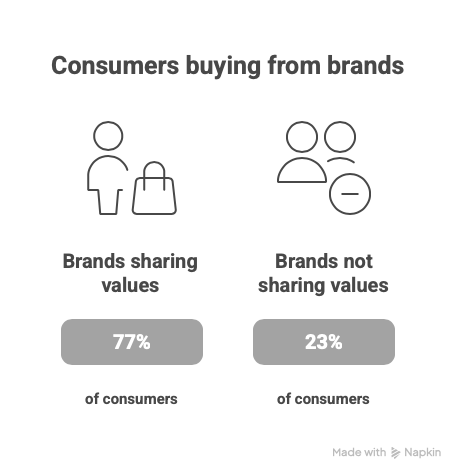
This informs the audience and announces your existence beyond money. The core idea, the problem, the lack of service, the unattended issue for which you started the company and built a business. A 2019 Havas Group study found that 77% of consumers buy from brands sharing their values, making purpose a competitive advantage. The brand follows the story and purpose because it connects them with their audience. It’s the human-centered cause that inspires your team and resonates with your audience. A strong purpose is specific, authentic, and emotionally compelling.
Brand Vision
Vision describes the future you are working for. It is your long-term goal, an objective you are planning to achieve in the next ten to fifteen years. Maybe more than that. Again, when you start working on it, do not set an unrealistic goal or ultra-big expectations. Things take time, but you cannot rely on being delusional with your branding objectives. It should be ambitious yet achievable.
Brand Mission
Lastly, there is the brand mission; it indicates how you are planning to achieve your brand vision. It encompasses actionable techniques and practical measures, fulfilling the role of a roadmap. A 2023 study notes that 64% of consumers feel an emotional connection to brands with a reinforcing mission’s role. For every brand strategy, a roadmap is essential and should have a clear construct of the brand mission. A simple tip would be to ask what specific actions you can take to realize our vision.
Do not work alone on this when you are operating to define brand vision, mission, and and values; involve teams, conduct workshops, and craft statements based on critical thinking and result-driven brainstorming sessions.
Step 3: Identify target audience & persona
In any brand strategy framework, the audience does play an important and irreplaceable role. After all, if there is no audience, there is no customer, and when there is no customer, you’ll have no sales, no revenue, and the business or the product will cease to exist. But we are not talking about just the demographics; you need to go deeper than that. You need to shape your customer; you need to give personality traits to your customers and work on their needs and pain points. Let’s decipher how you can move further in this.
Market segmentation
The most initial step you do is segment the market. This will help you narrow down the market size and reduce it to a more meaningful customer profile. Based on behaviors, needs, pain points, demographics, and other integral factors, you will have a better understanding of what your ideal customer is. A 2025 HubSpot study found that 86% of marketers report personalized experiences impact sales, but only 65% have high-quality audience data, highlighting the need for precision.
Customer personas
Yes, you need to use templates and tools to define a detailed customer persona. This will include everything and at the same time summarize everything from demographics (age, gender, income) and psychographics (values, interests, lifestyle) to goals, challenges, and decision-making behaviors.
Using empathy as insight
This is where it gets interesting, exciting, and insightful. As a founder or CEO, you use empathy as a powerful tool to understand exactly what the customer wants and needs because you empathize with them and try to comprehend their innermost feelings and motivations regarding your product or the brand you are selling. A 2023 study found that 70% of consumers feel closer to brands through content marketing, emphasizing empathy’s role.
Step 4: Craft Brand Positioning
If we follow the framework process, by now you are done with research, establishing brand vision, mission, and values, and have successfully identified your audience with proper detail. Next step, try exploring the brand positioning statement guide to craft brand positioning. 2024 study notes that 75% of B2B buyers’ purchase decisions are influenced by brand, underscoring positioning’s impact. Positioning is about claiming a unique space in your customer’s mind. Let’s learn how to do that.
Category definition
For effective brand positioning, first of all, categorize your product and brand to understand the niche you operate in. The more you cater to it, the more it will resonate with your choices. This allows you to understand where exactly your audience is coming from and whether you are placed in the right category with them or not. For instance, you categorize yourself as a health-based protein food company, but the audience sees you as a light snack manufacturer. This is misalignment and should be fixed.
Articulate Your Unique Selling Proposition (USP)
Your USP is the single most important factor that makes your product unique, original, and authentic in the market. It simply informs people that you are offering something that others are not. This USP answers the question, Why should customers be interested in your product compared to other alternatives?"" It assists in your endeavors of fathoming how brand strategy components play such a major role.
Strategic tools utility
As a founder, you should always be open to innovation and the use of technology. Employ templates, automate repetitive tasks, and use online tools to skip or work out processes that can hamper your productivity. This is important in a tight schedule and to increase efficiency.
Step 5: Define Brand Values, Personality & Voice
This is the fifth step, where you are about to add the real deal to your brand. Giving it a soul, a positive spirit to attract and communicate with your target audience. In this step you will cover the values, personality, and brand voice and work on consistency across all touchpoints.Let’s determine them one by one.
Core values
These are the values that are the foundation of your brand. You don’t have to prepare a list. Focus on three to five core values that guide your brand’s decision-making process and strategic movement. Remember, these are your non-negotiable principles that, as a brand, you won’t compromise on. Do not confuse it with marketing jargon that you can change as you please. A 2023 study notes that 76% of consumers avoid brands that mistreat employees or the environment, tying values to loyalty.
Brand personality
Treat your brand as a human, and then think of all the traits you want to add to its identity, appearance, and characteristics. Bo, it’s not the features we are talking about. Set aside the functions and benefits of your brand. Focus on key personality that you want to carve for your brand that will resonate with its target audience. A 2024 study found that 91% of consumers recognize Google by its colors alone, showing personality’s visual impact. Whether your product is trustworthy, playful, or on point is defined by the brand personality.
Brand voice and brand tone
When you create brand personas, again, a very crucial element in branding follows, which is the brand voice and tone. The brand voice is the communication style you bring in, and the brand tone is the way you say what you want to express through your brand content. You have to carefully draft and craft the tone and voice of your brand; otherwise, everything you want to say can shift in the wrong direction. To define your voice, ask: If our brand were a person at a dinner party, how would they be described?
Step 6: Develop Key Brand Messaging
Once you are done with your brand voice and tone, you must start focusing on brand messaging. A 2024 study found that 79% of purchasing decisions are influenced by user-generated content, emphasizing the need for authentic messaging. What exactly is it that you want to express and deliver to your target audience and potential customers? Messaging brings your strategy to life through language. Your brand voice and messaging must go hand in hand. Again, a simple pro tip would be to always hold hands with clarity and never let go of the consistency. Let’s decode the aspects of effective brand messaging.
Crafting a tagline
A short and crisp tagline that speaks volumes about the effect you want to create with your brand. It should be memorable and at the same time encapsulate the essence of your brand. A very simple yet iconic tagline example would be Nike’s “Just Do It.” Just a three-word phrase that delivers the exact expression that the company wants its audience to feel. Aim for brevity and impact, ensuring the tagline aligns with your purpose and positioning.
Speak of value proposition
Your value proposition is what makes you unique. You have to put enough stress on it. n a nutshell, a value proposition is a clean and clear statement that articulates the product’s unique benefit that it is willing to offer and makes the difference.
Create an elevator pitch
This pitch cannot exceed cond summary that should be well written and learned by heart by everyone on the team. So when the time comes to pitch, this can be done by anyone, and the team doesn’t have to wait for the manager or team lead for this. Primarily, it should cover who you are, what you do, and why it matters.
Core Messaging
These are again a series of well-crafted messages that you want to communicate consistently across all your channels, digital footprints, and online platforms. A 2025 study notes that 54% of consumers want more video content from trusted brands, suggesting a medium for messaging. It never really has to be only one, but if you are planning to have more than three core messages make sure they all are in sync and form a pattern.
Leverage Storytelling
Use storytelling to your advantage. Give your brand story a narrative. Talk about your challenges, struggles, achievements, and roadblocks. In this structure, your customer is the hero, and your brand is the guide. Create a narrative that sticks, a narrative that connects with your audience, and then you can become more sure about the leads and conversions because the customer is now coming from a different thought process, from a more personal connection.
Step 7: Integrate into Brand Identity & Experience

Strategy has to translate into actions and become meaningful experiences. A 2023 study found that 90% of consumers expect consistent branding across channels. When this happens, you can successfully conclude that the brand is active, alive, and has made its mark in the market and surely in the audience’s mindset.
Visual identity
Everything from your logo design, typography, colors, imagery, and even the spacing between words and letters should reflect your strategy. I know at first it sounds unrealistic, but trust me, if you work with the right people and branding firms, you’ll reap the real ROI of hiring a brand consultant.
Brand touchpoint
Every point of communication that is present, you will have to cover them all, and that too with consistency. The audience cannot get confused reading one thing on the website and another thing on a social media post. Each touchpoint should reinforce your strategy.
Internal alignment and culture
You’ve always heard that the real problem often lies on the inside. The only solution for this is to train employees on purpose and make them realize and value your vision, mission, and brand messaging. A 2023 study notes that 78% of organizations see employer branding as critical to business strategy. Each employee must have a clear understanding of the product and must not sell their own versions to the people.
Develop better creative briefs
Lastly, you should focus on drafting better creative briefs for your brand. Use your brand strategy to guide creative work. A strong brief outlines your positioning, audience, and messaging, ensuring all campaigns align with your vision. For instance, there is the Coca-Cola example. When the beverage company launched its “Taste the Feeling” campaign, it was everywhere on its ads, packaging, social media handles, and website. Create a brand style guide to document your visual and verbal identity. Regularly audit touchpoints to ensure consistency and close any trust gaps.
Frameworks & Models
Here is a brief list of four brand strategy frameworks and models that you can use apart from the seven-step process that we discussed extensively.
Golden Circle by Simon Sinek: This one begins with purpose and then moves towards process and products. This same framework has helped Airbnb clarify its “Belong Anywhere” purpose.
Brand Identity Prism by KapfererIn this framework, there are six facets, which are physique, personality, culture, relationship,reflection, and, and self-image.
Brand Pyramid: This pyramid contains functional benefits, emotional benefits and brand essence.
Brand key model: This is a proprietary framework that largely focuses on competitive environment, target, insight, benefits, and,ain,n, brand essence.
Tips for Success
Here is a quick list of tips that you can incorporate into your brand strategy framework to ensure success:
Staying consistent—FollowFollow the plan, stick to the framework, and do not drop in betweenStay consistent with your operations and branding tasks & activities.
Focused—Technically,- Technically this is a subpart of staying consistent. You cannot bring in distractions and take your brand strategy for grantearly—brin
Partner early—brinfromeveryone from the employees, stakeholders, and the internal team together and start early.
Employee SWOTanalysis—This—Thiswill give you a sound perspective of everything and wildecision-cision-making easier.
Common Pitfalls to Avoid
As we are reaching the end of this brand strategy framework blog, where we started with what is brand strategy we have reached the phase where we discuss the common pitfalls that you can avoid when creating your framework.
Dropping research: Research offers data can be turned into information leading to insights. Without insights it becomes impossible to make wise decisions, so never skip it in the first place.
Overcomplicating processes: I’ve worked with people who just like to bring in the complexity into the equation. A simple tip would be that along the way, you’ll come across many pitfalls ocomplications;s; do not fall for it. Keep things simple.
Ignoring internal alignment: This usually happens when businesses arpivoting.ng. IfIfou are somewhere in the middle of your rebranding strategy steps, focus on bringing everyone on the same page. Make sure they all have the same idea and concept in their minds.
Following trends: Do not fall for this; your focus should be to align brand and marketing strategy. If you will follow trends, they will not help you in creating a strong foundation and your own brand identity.
Conclusion: build with intent
Always remember nothing, all the efforts you are putting into the brand strategies to create a perception of your brand. Your goal is to project your brand in such a way that your target audience must feel inclined to have it. Your brand perception is shaped by clarity, consistency, and connection which comes from a disciplined brand strategy framework. We discussed the seven-step process in detail,followed by statistics and real brand examples brought to life through execution. Great branding begins with a strategy. This blueprint guide will assist you in moving beyond guesswork and creating a brand that stands the test of time.